Norwegian architecture firm Snøhetta and Italian furniture producer Citterio introduce Borealis, a new modular seating system
OnOffice speaks to Marius Myking, director of Snøhetta Product Design, an industrial studio within the Snøhetta family, to find out more about the collaboration.

OnOffice: What did you consider in particular when thinking about this new product?
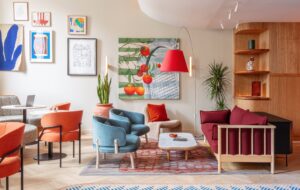
Marius Myking: Together with Citterio we wanted to create a modular seating system that could live comfortably in many different contexts – offices, hospitality, public spaces, lounges and waiting areas – without needing a new language for each situation. This meant focusing on a few key aspects: a clear architectural logic, a calm and honest material expression and real flexibility. The frame had to feel like a piece of refined joinery rather than a hidden support, and the upholstered elements needed to be soft and generous but still precise. We wanted Borealis to have enough character to stand on its own, while remaining neutral enough to support very different kinds of spaces and interior styles. So the collection was always about more than individual sofas or benches. It was about creating a coherent family that designers and clients can use as a tool to shape space in a simple, intuitive way.

OO: How did you apply Snøhetta’s architectural know-how to Borealis?
MM: We’ve seen first-hand how our architects and interior designers build environments and spaces for the people who inhabit them. When developing Borealis, our goal was to create something that could become a positive addition to many different spaces without taking away the qualities of the architecture around it – a design that complements, rather than takes over.
We approached the system almost like architecture but on a smaller scale. The exposed oak frame acts as a kind of structural grid, setting up order and rhythm, while the soft volumes sit inside that framework. The square module and the way elements connect mean you can use Borealis to quietly structure a space – opening it up, making it more intimate, guiding flows of people – without it feeling heavy or dominant.
The CMF and the high quality in materials and comfort are important to this, but so is the engineering behind it. A lot of complexity goes into making something that feels calm and simple to use.
At the same time, Snøhetta Product Design is not just “architecture doing furniture on the side”. It is its own industrial design studio within the Snøhetta family. We don’t focus on designing furniture only for our own projects – instead, we leverage the shared knowledge from our architectural and interior work to design for a broader market. That allows us to create products like Borealis that are rooted in spatial understanding, but developed as standalone, market-relevant systems in close collaboration with partners like Citterio.

OO: Did you design longevity into Borealis and if so, how?
MM: Longevity was a fundamental part of the brief from the beginning. On the most basic level, it’s about robust materials and construction: solid oak, high-quality textiles and connection details that are engineered to last and to be maintained over time. The separation between the structural frame and the soft elements also makes it easier to re-upholster or refresh parts of the system without discarding the whole piece.
Just as important is functional longevity. Because Borealis is based on a strict yet simple module, the same family can be reconfigured as needs change – a reception area can become more of a collaborative workspace, a lounge can be opened up or divided, without changing the underlying language.
And finally there is aesthetic longevity. We deliberately aimed for a restrained, structural expression rather than something overly styled or trend-driven. By grounding the design in proportion, materiality and comfort, our hope is that Borealis will remain relevant for many years, even as work life and interior trends continue to evolve.

Photography by Snøhetta
Find out more via Snøhetta’s website here and Citterio’s website here.