Leading the charge is Lollipop, Deadgood’s latest chair. A robust timber piece that takes its cues from the humble wooden lolly stick, it has a super-light silhouette and a playful aesthetic.
“With a background in designing for ‘emotional durability’, I’m always looking to inject a sense of fun or nostalgia into furniture. Creating that instant, subconscious connection is the ultimate way to spark joy,” says Vicki Leach, Deadgood’s design director. “During the design process, when the leg started resembling a lollipop stick, the narrative connected perfectly, giving the chair a relatable, playful identity that people instantly latch onto.”

The chair uses traditional joinery techniques, with each component pressed from plywood, striking the perfect balance between character and durability. “While the chair is playful and a little irreverent, it is also aesthetically mature and structurally robust,” adds Leach. “It’s a bit of a chameleon; I can see it working beautifully in a high-end restaurant, a museum, or a contemporary workplace. It can play many different characters, leaving it open for interior designers and architects to use it to evoke whatever mood they want to convey. It has been rigorously tested to the EN 16139 contract standard, so we really want to see it put to the test in high-traffic public spaces.”
Established in 2004 by university friends Dan Ziglam and Elliot Brook, Deadgood has built a reputation for thoughtful, expressive design. The studio’s relationship with plywood goes back more than 20 years to its very first product, the Form Chair. “Fast forward to today, and we’re still not tired of it – it’s an incredibly versatile material that we love experimenting with,” says Leach. “For the Lollipop Chair, we use locally sourced, FSC-certified timber manufactured in Poland. Finding the right partner was a challenge; while ply-pressing is a common process, few manufacturers in the UK have the specialised set-up required for a design this complex. Partnering with the right experts in Europe allowed us to achieve the perfect balance of technical precision and sustainable sourcing.”

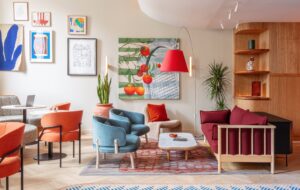
Lollipop arrives alongside more new launches. The original Folk sofa family has been expanded with a smaller, more flexible sibling that offers two heights and an integrated shelf. The HB Table, a collaboration with London studio AtelierThirty Four, mixes playful 1960s shapes with architectural logic. And Wall’s End, designed by Heirloom, introduces mobile partitions for flexible workspaces. The new launches can be seen at Deadgood’s two-storey Clerkenwell space, which has been refreshed by Trifle* in time for Clerkenwell Design Week.
Furthermore, Deadgood now offers a Design Conformity Furniture Passport for all its pieces. An infographic presents easy-to-understand information about the furniture’s carbon footprint, while a QR code offers the opportunity for a deeper dive. “From day one, we’ve tried to do right by the planet. Circular thinking, furniture built to last, a local supply chain and a platform for young British designers,” says co-founder Elliot Brook. “When we collaborated with Design Conformity on our lifecycle analysis, they told us passports were heading into legislation over the next few years. So we worked closely with them to document our whole range. The traffic-light system means that you can see at a glance whether a product is doing right or wrong by the planet, with the full data set behind a QR code for ease of access. That’s the point. Document circularity so people actually get it, and the right products become easier to specify.”
To find out more, visit Deadgood’s website here.