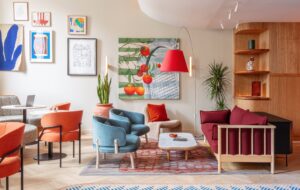
We sit in a chair for only 30 minutes while we have our coffee. We celebrate it. We admire it. Photograph it. Write books about it. We showcase it at design fairs and place it at the centre of beautifully curated interiors.
Yet we rarely give the same attention to the chair that we spend up to eight years of our lives in. That contradiction raises a simple question: why is one of the most used design objects in modern life also one of the most overlooked?

For decades, the office chair has occupied an unusual position in the design world. It influences our health, our comfort, our concentration and, increasingly, our wellbeing. It is one of the few objects that many of us interact with for thousands of hours in the course of our careers. Yet unlike lounge chairs, dining chairs or statement furniture pieces, it rarely enjoys the same cultural status.

At Savo, we recently explored this question through a study of 10 years of design weeks and five years of editorial coverage across leading design publications. What we found was striking.
Office seating accounted for just 8.1 per cent of exhibitor entries across the design weeks that we analysed. Lounge chairs received more than 2.3 times the visibility. When office seating did appear, it was overwhelmingly framed through function: ergonomics, productivity, adjustability and performance.

Of course, these things matter enormously. Good ergonomics support healthier bodies, better work and improved wellbeing. Today, 1.71 billion people globally live with musculoskeletal conditions, with lower back pain remaining the leading cause of disability in 160 countries.
The chair we sit in every day is not a trivial object. But when function becomes the only story, we limit the potential of the category.

The world around us is changing. Hybrid working has blurred the boundaries between home, work and lifestyle. Employees increasingly expect environments that feel inspiring, personal and human. At the same time, there is a renewed appreciation for sustainability, longevity, repairability and enduring design. In the UK alone, about 1.8 million office chairs are discarded every year, highlighting how much work remains to be done in creating products that people value and keep for longer.
Design culture is changing too. We are moving away from sterile perfection and towards spaces that feel lived-in and expressive. The objects that we surround ourselves with are becoming reflections of identity, taste and values rather than simply tools.

Why should office seating be excluded from that conversation? The office chair is no longer just workplace equipment. It is one of the most intimate design objects that many of us own. It supports us through ideas, conversations, challenges and achievements. We spend more time with it than almost any other piece of furniture.
Perhaps it is time we stopped seeing office seating as something that belongs in the background. It is time to stop treating office seating as equipment and start recognising it as design. It is time to move it from the back seat to the front row.
Find out more over on Savo’s website here.