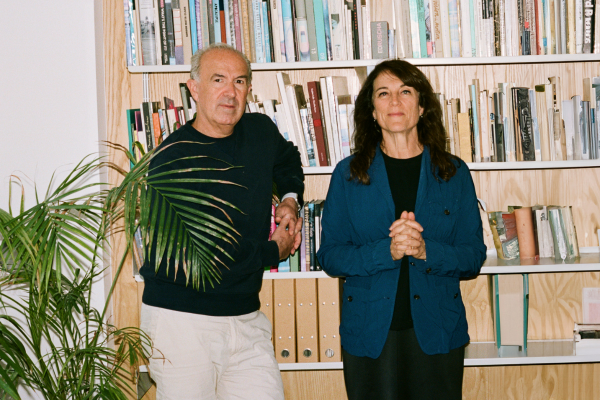
London-based studio Industrial Facility, co-founded in 2002 by designers Sam Hecht and Kim Colin, takes a thoughtful approach to contemporary life.
It’s a perspective that leads to beauty as well as utility in their products, furniture and exhibitions

When Sam Hecht imagines the image of a chair after a room empties, it is not a poetic interlude but a design problem. “When we leave,” he says, “does the room still exist? What is the chair doing? It still has a relationship to the walls, the floor, the other things in the space.”
While most briefs stop at the user, Industrial Facility considers the context.
Because a chair is not just a relationship between body and material – it is also a permanent resident of a room, with obligations to its surroundings. Design that ignores this, Hecht suggests, isn’t doing the whole job.

The London studio Hecht runs with his partner Kim Colin is approaching its 25th year. In that time, they have applied their deep design thinking to furniture, lighting, medical equipment and product design, with clients ranging from Herman Miller and Muji to Mattiazzi and Wästberg.
The result is a sizeable body of highly considered pieces, and the flow continues – they have launched three chairs and a shelving system this year alone.
What has remained a constant across the years for the philosopher-designers is the conditions they require to embark on a project.
For any collaboration to be worth doing, Hecht argues, one party must know something that the other does not. The manufacturer might have decades of knowledge in a material – wood, aluminium, LED technology – while the studio arrives knowing little about it but finding it fascinating.

Or the reverse: the client enters new territory while Industrial Facility brings its know-how from prior work. “Things get boring when both parties are experts,” says Hecht. “And it’s an absolute disaster when both are naïve.”
A new relationship with Danish brand &Tradition has been a particularly successful dynamic. &Tradition understands interiors – how rooms are composed and how objects inhabit them – which fascinated the designers.
Two quite different products have come out of the recent collaboration.
Rombe, a shelving system, began with a very specific instruction from the brand: in Danish homes, all surfaces are precious, from the floor to the walls.
Could they make a shelf that impacts the wall as little as possible? The answer took three years of engineering.
The resulting system fixes at only a few points while everything else stands clear of the wall. Brackets hook and slot from behind the extrusions, invisibly.

No fixings, no tracks, no adjustment mechanisms are on show and, should you ever wish to move it, there are just four holes to fill. Kape, the chair that the pair have just designed for &Tradition, developed from a harder question: is there anything we can do to easily replace a chair’s upholstery?
Typically, glue, foam, fabric and frame are fused in the making of a chair, prohibiting renewal. &Tradition, now a B Corporation with measurable sustainability commitments, brought this conundrum to the studio at the start of the process, not the end – and it defined the entire project.
The idea of something that can be repaired – it’s kind of an epilogue,” Hecht says of the industry norm. “It’s right at the end.”
The turning point came when Colin asked why repairability couldn’t be given the same design priority as comfort, stackability and proportion.
What followed was a chair built around two upholstered gloves, for the back and the seat.
They slip on like tailoring and are closed with a zip. No glue is required and the fabric can be replaced.
The structure needed to make this work produced its own design moment: without a conventional front leg that would hinder the removability of the upholstery, an extreme cantilever had to be engineered, which achieved not only a striking profile, but space for the sitter to turn and perch, their legs unhindered, on the corner.
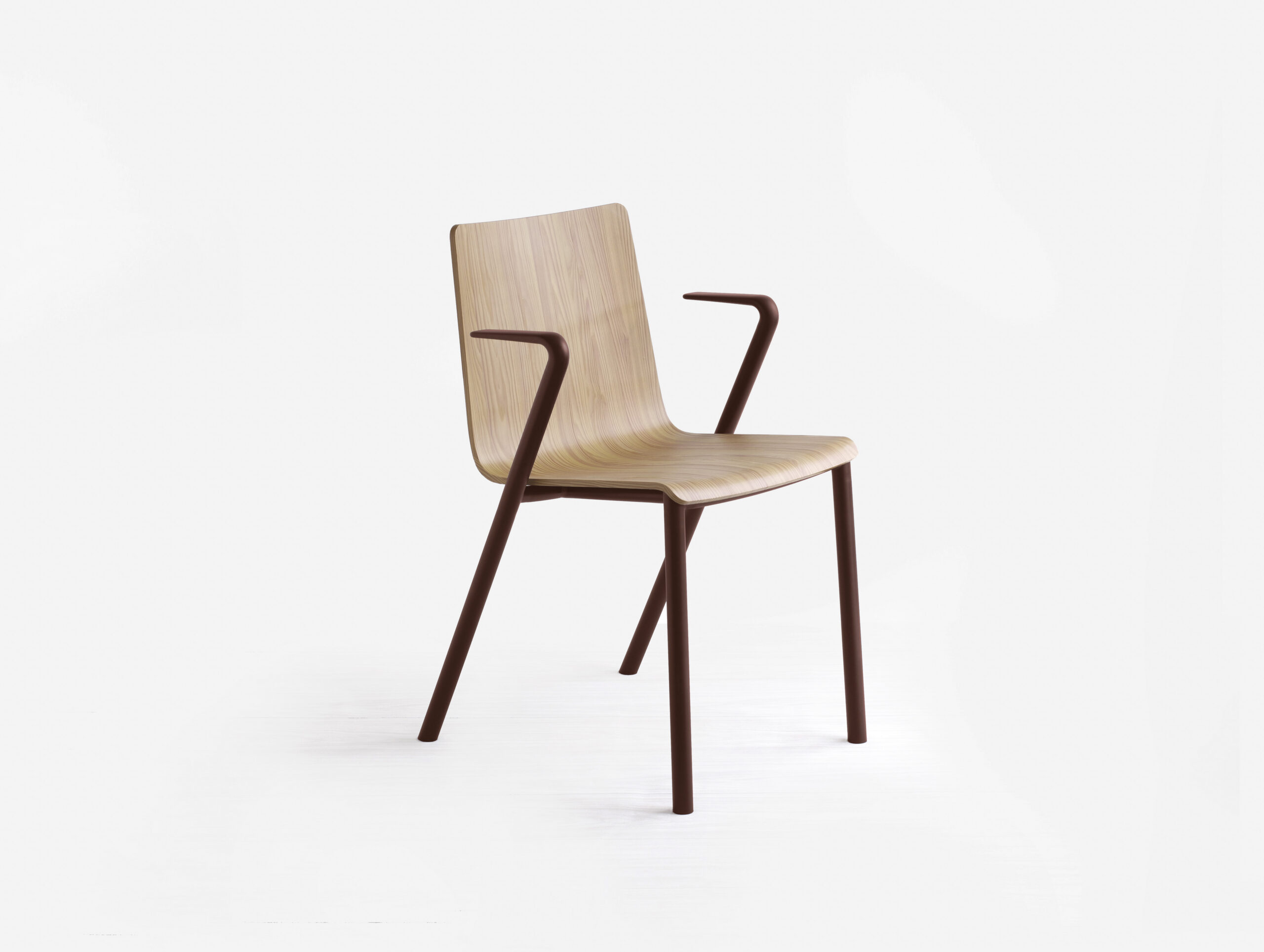
Arrived at through functional necessity, the form feels both original and utterly timeless. Hakusan, produced for NII – a new designfocused offshoot of Japanese office furniture manufacturer Itoki – sits in contrast to Kape.

Where Kape is all hidden complexity, Hakusan is visible economy: a moulded plywood seat, steel legs, the back two rising at an extreme angle to then turn – with a near-invisible junction – to form a partial arm rest.
Industrial Facility brought the expertise in steel, plywood and office systems logic built through years with Herman Miller, while Itoki provided the market knowledge and cultural context.
Japan’s younger creatives are working more fluidly, in spaces that need a different kind of workhorse.
The chair stacks cleanly with a sliding action, balances naturally when lifted by the arms, and its design is quiet enough to multiply across a room. “You can take the same materials,” says Hecht, “and make them worth more.”
Another long-time collaborator is Mattiazzi, and the two parties know each other’s capabilities well.
But what shifts the equation with Stelo, the latest family of chairs for the Italian wood specialists, is the typological challenge.
The Windsor chair – English in origin, translated across the world, assembled by different craftsmen making different parts at a time when that made sense – should be obsolete by now.
But it has mutated and survived across centuries and continents. Hecht traces his own memory of it to the captain’s chair in Bonanza, the 1959 American Western – designed to leave a gunslinger’s holster unobstructed.
The history of transformation has given Industrial Facility a licence to take the chair’s essential language and rework it with the technical precision and material honesty that Mattiazzi’s process affords.
Across all four new pieces, what Industrial Facility is making are not chairs and shelves so much as a case for longevity over replacement, for structural integrity over visual effect, for the object that still does something when the room is empty.
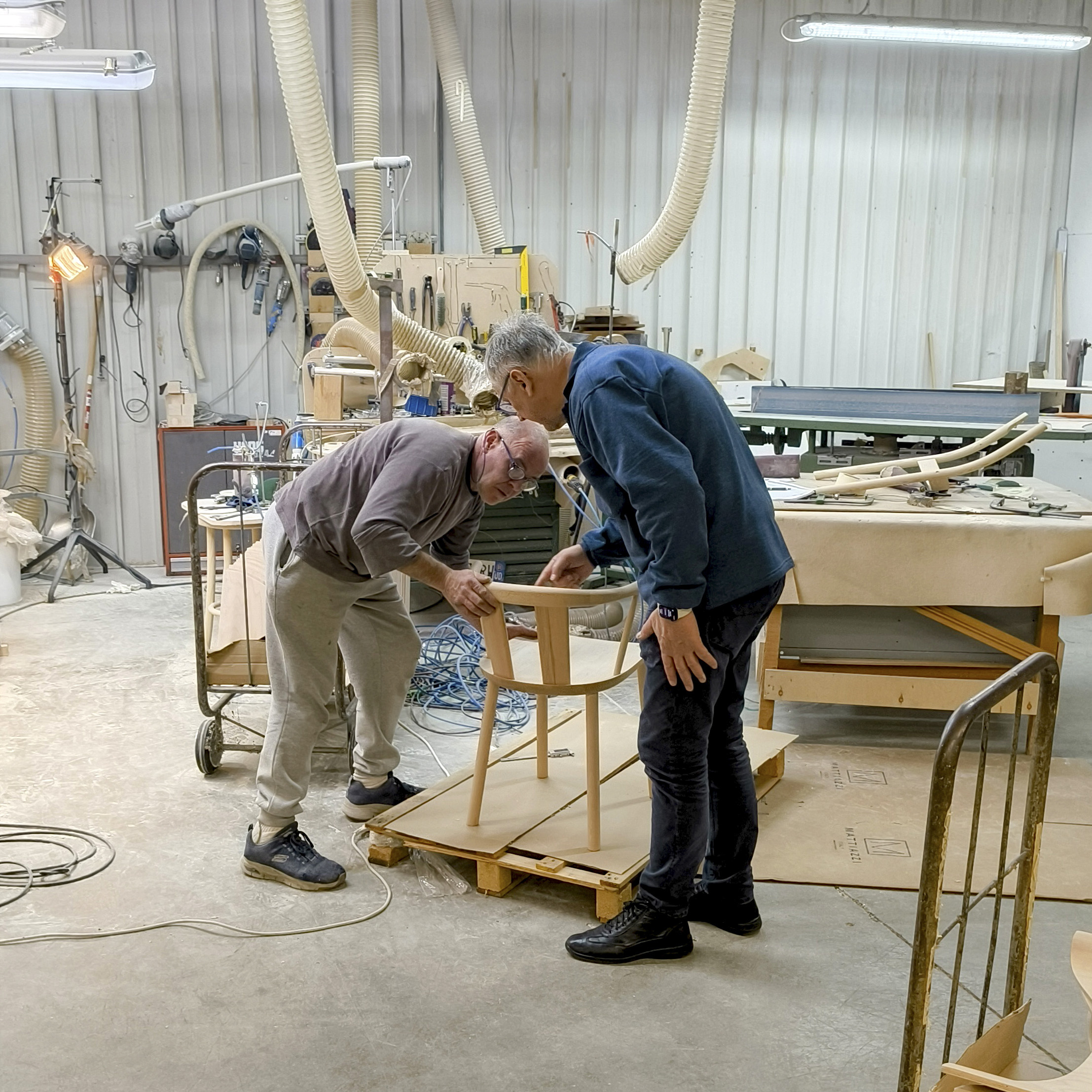
Fortuitously, they have a habit of making their point with designs that turn into icons.
Photography courtesy of &Tradition & Kane Hulse